Conference technology: different PA scenarios and what you need to make sure everyone will be heard
Find out more about our tips for effective sound technology at conferences.
There are basically two modes for conferences: one person speaks to many or many people speak with each other. What both have in common is that speech should reach all participants.
What are you particularly interested in?
The minimum requirements for a conference with audio gain
Inputs: a way to put sound into a sound system. For acoustic sources, such as voices, the input is typically a microphone.
Signal processing: as the name implies, the signal entering the input is somehow altered. There are two types, mixers and more specialised signal processors. A mixer combines signals from different sources and processes from two to several hundred inputs. Other signal processing devices provide various helpful functions.
Amplifiers: these devices combine the individual channels and increase the level. The amplifier can provide features that the signal processing also offers, and vice versa. Items 2 and 3 regularly overlap.
Outputs: what goes in at the input should reach the listeners as clearly as possible. The output is usually a speaker, headphones or in-ear monitor.
Inputs: which microphones for conferences?
Put yourself in the shoes of the audience: what kind of microphone would you be happy with? Here we give only a brief overview of the most important versions:
And it is an art whose subtleties are unknown to most people. That is why it is generally good to relieve speakers of this burden. Furthermore, you thus enable speakers to gesticulate more naturally, which lowers the barrier to the audience.
A small group of people can hold a conference without PA technology. However, there are cases where amplification would be still useful, even if the audience is not very large. In those cases, the characteristics of the venue are relevant:
- Size of the room
- Existing furniture
- Carpets and curtains
- Ceiling height
If you know that the venue is acoustically challenging, it is advisable to equip the speakers with microphones. Another reason for microphones can be the necessity to simultaneously translate multiple languages. Then one or more interpreters sit in isolation booths, listen and translate in real time. Their audio signals go to the central unit, which then relays them to target units. This is usually done via headphones, not speakers. This is where a tour guide system makes sense for smaller groups that need translation.
Signal processing: small helpers, big impact
Signal processing concerns devices that help solve a variety of problems in the signal chain. This can be achieved in various ways:
- Easy sound and volume adjustment
- Feedback control
- Dynamic effects such as compression or limiting
- Automatic mixers (rarely relevant for conferences)
- Echo suppressors (rarely relevant for conferences)
- Time-based effects such as reverb and delay (rarely relevant for conferences)
Remember, it is always better to prevent problems in the signal chain instead of solving them afterwards. The most important thing remains the optimum positioning of microphones and speakers.
Signal processing is usually part of the mixing process, where several devices can be connected in series. While most systems for speech transmission have limited processing options, it is useful to know the basic functions of each type of processor. The following functions are relevant for conferences:
- An equalizer influences the frequency response of the signal, increases the bass range and can thus impact e.g. speech intelligibility.
- A noise gate can really work wonders at conferences when it comes to reducing unwanted background noise. Especially when it is unavoidable that several microphones are active at the same time. It works like this: the output signal is switched off ('gated') when the level falls below a certain threshold. So, if three microphones are open, but only one person is speaking, the audience will not hear any rustling of clothing or handling noises via the other two microphones.
- An (RMS) compressor reduces the dynamic range of a signal by reducing volume differences between the loudest and the quietest signal. This is done by reducing the level of all signals above a certain user-defined threshold by a certain amount. The amount of reduction is expressed as a ratio. The higher the ratio, the more the volume of loud signals is reduced. Some compressors feature presets for specific scenarios. You should consider these if you do not want to deal with attack, sustain, decay and release in detail yourself. A general rule says, longer attack times sound more natural, but can miss signals that should actually be compressed. Short attack times, on the other hand, are more effective in preventing loud transients.
- A limiter is useful for avoiding distortions and protecting the components of the PA system, especially the speakers. It reduces signals above a certain threshold by a certain ratio. A limiter is basically a reverse compressor and usually the last device in the signal path.
The amplifier: volume and channel connection
Outputs: speaker (systems) or tour guide systems?
Speaker systems: speech situation few to many
At conferences, either mobile PA systems or wall speakers and ceiling speakers are used. Due to their extremely precise sound radiation and the frequency range, column speakers such as the ETS-360TW/WS are suitable for various applications: lectures, panel discussions, but also for official celebrations with background music. The two bass speakers, four bass-midrange speakers and the tweeter produce a sound pattern that also transmits voices particularly well. A basic understanding of RMS power and audio levels is helpful here.
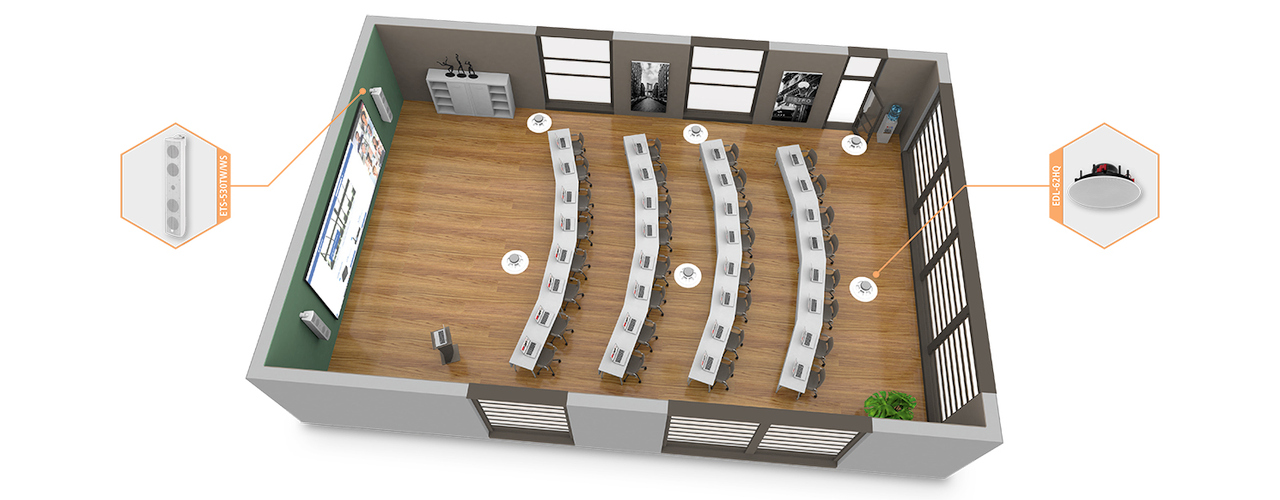
Application example: Seminar room, approx. 80 m²
High-quality loudspeakers and microphones are absolute must-haves when equipping seminar rooms in order to achieve good speech intelligibility. In this example, two ETS-530TW/WS sound columns are installed to the left and right of the projection screen. The 2-way loudspeakers blend discreetly into the room and transmit speech and music in high quality. In addition, EDL-62HQ ceiling-mounted loudspeakers ensure uniform sound coverage throughout the entire room. The volume is consistent throughout the room and is neither too loud nor too low. This ensures that the spoken word can be heard clearly even by listeners in the back row. The 100 V speakers with 2-way technology are equipped with an attractive metal protective grille and blend inconspicuously into their surroundings.
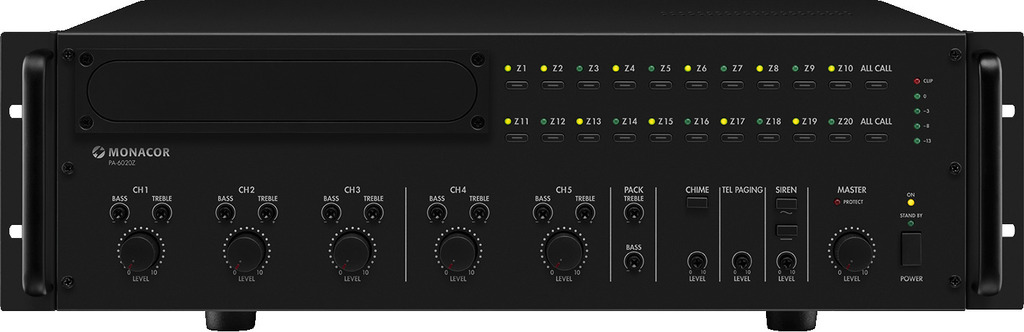
The professional PA-M224 matrix amplifier ensures powerful audio reproduction and offers reliable routing of up to eight different audio sources for two zones. The volume and sound can be adjusted differently for each zone according to requirements, allowing front and ceiling speakers to be controlled independently of each other.
If required, audio signals from any Bluetooth device (e.g., notebook or smartphone) can be received via the WSA-20BT Bluetooth receiver and played back via the sound system in the seminar room.
The complete solution: a professional lectern, for temporary or permanent microphone stations
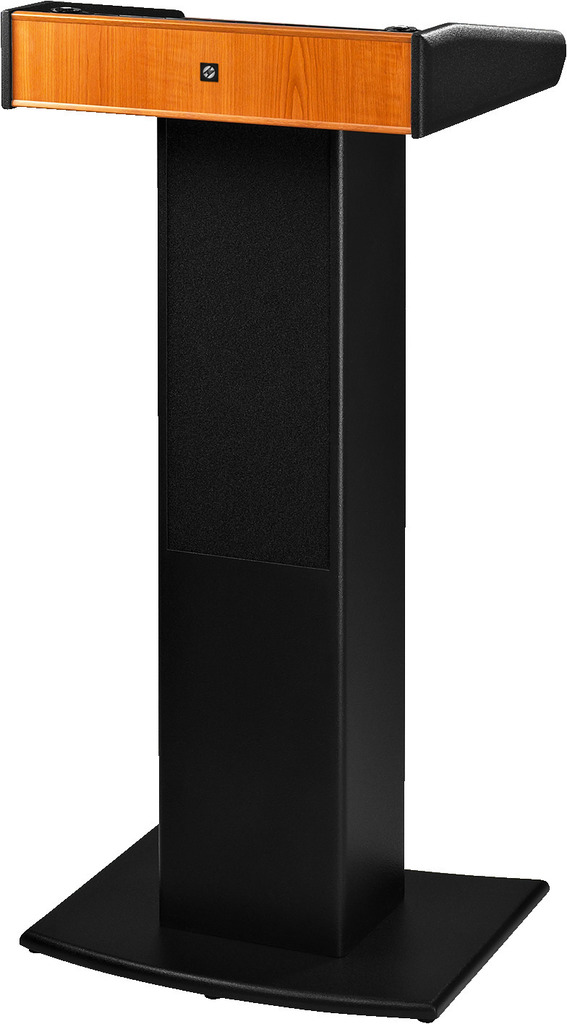
Integrated amplifier technology and speaker technology make active lecterns like the SPEECH-104D solutions with which nothing can go wrong.
If you are speaking as an individual to many listeners, a quick solution that does not require a big accompanying system would be appropriate for speech reproduction and dubbings of films or presentations. Here, we would recommend a gooseneck microphone.
A lectern solves many problems at once: amplifiers and 2-way loudspeakers are built in, and connections for additional loudspeakers (NEUTRIK-SPEAKON) and microphones (XLR) are located in easily accessible places. And anyone who has ever spoken at a lectern knows that it makes a difference. Standing upright, we speak with more confidence, our arms can rest on the lectern, and our notes disappear behind a small screen. And let's be honest: it just looks more professional.
The SPEECH-104D active lectern from MONACOR perfectly combines sound quality, volume capability, and comfort. Battery-powered and therefore completely location-independent, the SPEECH-104D alone can turn any area requiring sound reinforcement into an auditorium. Of course, it also fits into any given environment where a temporary or permanent speaking position is required. The integrated amplifier and speaker technology not only allows for voice reproduction, but also makes music and, for example, film and presentation soundtracks conceivably good and easy. Plug in a gooseneck microphone and/or connect a signal source – switch on – done.
Tour guide systems: speech situation many to many
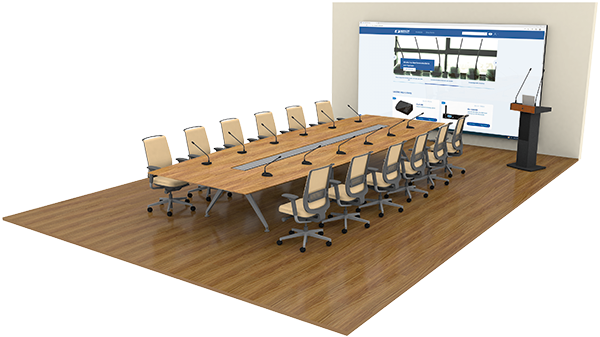
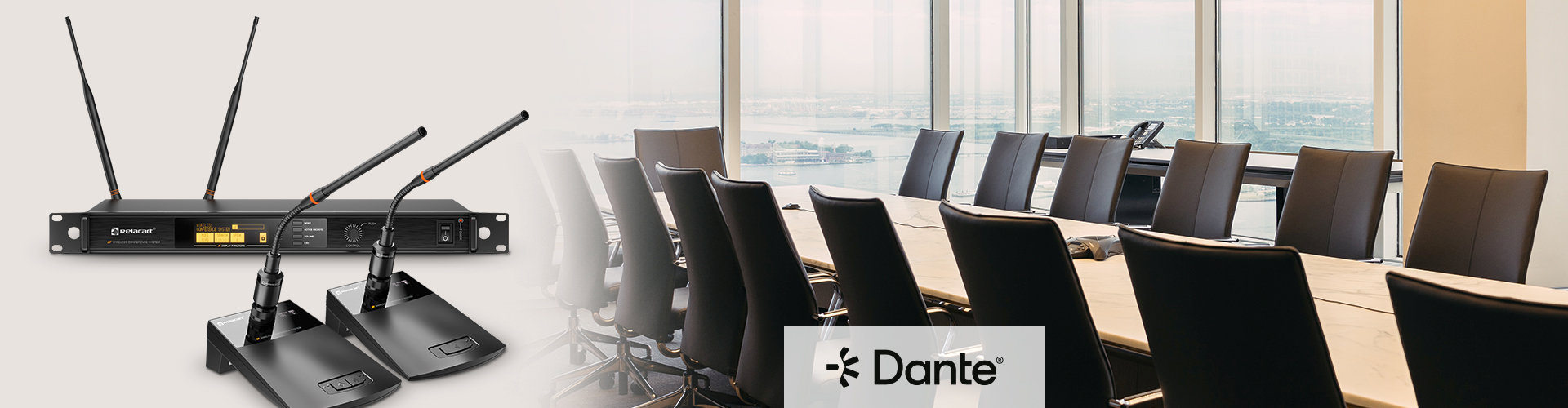
Systems for 2-way communication make sense, if there is to be an active exchange among participants. Systems like the ATS-80ST transmit up to 42 channels in parallel. A microphone will be connected via the corresponding transmitter, every listener gets a receiver. For a situation where many speak with many, the conference system with individual desktop microphones from JTS is also worthwile.
What to do in case of acoustic feedback?
First aid for feedback: lower the (master) gain to stop the annoying howlback. So far, so easy. Feedbacks are often caused by a badly placed microphone or incorrectly positioned speakers. In the end, good sound without feedback always means balancing the necessary acoustic gain as accurately as possible. Too much level in the PA system is not good, still, every person in the room should have the optimum sound. Here are some quick tips:
- Reduce the number of open microphones. That also reduces the number of possible interferences immediately.
- Use directional microphones with cardioid and supercardioid polar pattern. This also applies to speakers, i.e., they should be aligned as precisely as possible.
- If possible, set up the speakers closer to the audience.
- Put the microphones as close as possible to the sound sources (in most cases the person speaking). Or rather the other way around, the speakers should sit as close to the microphones as possible.
- Position the microphones in a way that puts the intended sound source onto the axis, where the zero point of the polar pattern is used to avoid unwanted noises.
- Use a feedback controller, as in this example, that automatically eliminates the irritating feedback frequency with minimal effect on the remaining level.
We are happy if we can make your daily project routine easier for you as an installer and expert planner. That is why we are a solution provider, not just a retailer. Your Project is Our Project.